Risk in a Revenue Producing Project Can Best Be Adjusted for by
The net nowadays value (NPV) or net present worth (NPW)[1] applies to a series of cash flows occurring at different times. The present value of a cash flow depends on the interval of time betwixt at present and the cash flow. It besides depends on the discount rate. NPV accounts for the time value of money. Information technology provides a method for evaluating and comparison capital letter projects or financial products with greenbacks flows spread over time, as in loans, investments, payouts from insurance contracts plus many other applications.
Fourth dimension value of money dictates that fourth dimension affects the value of cash flows. For instance, a lender may offer 99 cents for the promise of receiving $1.00 a calendar month from now, but the promise to receive that same dollar 20 years in the futurity would exist worth much less today to that same person (lender), fifty-fifty if the payback in both cases was equally sure. This decrease in the electric current value of time to come cash flows is based on a chosen charge per unit of return (or discount charge per unit). If for example there exists a time series of identical greenbacks flows, the cash catamenia in the present is the virtually valuable, with each future cash catamenia becoming less valuable than the previous cash flow. A cash flow today is more than valuable than an identical cash flow in the future[2] because a present flow can be invested immediately and begin earning returns, while a futurity flow cannot.
NPV is determined by computing the costs (negative cash flows) and benefits (positive cash flows) for each period of an investment. After the cash flow for each catamenia is calculated, the present value (PV) of each one is accomplished by discounting its future value (see Formula) at a periodic rate of return (the charge per unit of render dictated by the marketplace). NPV is the sum of all the discounted future cash flows.
Because of its simplicity, NPV is a useful tool to decide whether a project or investment will upshot in a net profit or a loss. A positive NPV results in profit, while a negative NPV results in a loss. The NPV measures the excess or shortfall of cash flows, in present value terms, above the cost of funds.[3] In a theoretical situation of unlimited capital budgeting, a company should pursue every investment with a positive NPV. However, in practical terms a company'due south capital constraints limit investments to projects with the highest NPV whose cost greenbacks flows, or initial cash investment, practise non exceed the company's majuscule. NPV is a fundamental tool in discounted cash menstruation (DCF) analysis and is a standard method for using the fourth dimension value of money to appraise long-term projects. It is widely used throughout economic science, financial assay, and fiscal accounting.
In the example when all future cash flows are positive, or incoming (such as the principal and coupon payment of a bond) the only outflow of cash is the purchase price, the NPV is simply the PV of future cash flows minus the purchase price (which is its own PV). NPV can be described as the "departure corporeality" between the sums of discounted greenbacks inflows and cash outflows. It compares the present value of money today to the nowadays value of money in the time to come, taking inflation and returns into account.
The NPV of a sequence of cash flows takes as input the cash flows and a discount rate or discount curve and outputs a nowadays value, which is the electric current fair price. The antipodal process in discounted cash catamenia (DCF) analysis takes a sequence of cash flows and a price as input and as output the discount charge per unit, or internal rate of return (IRR) which would yield the given price every bit NPV. This charge per unit, called the yield, is widely used in bond trading.
Many computer-based spreadsheet programs accept built-in formulae for PV and NPV.
Formula [edit]
Each cash inflow/outflow is discounted back to its nowadays value (PV). And then all are summed such that NPV is the sum of all terms:

where
- is the time of the greenbacks menses
- is the disbelieve rate, i.e. the render that could be earned per unit of fourth dimension on an investment with like risk
- is the internet cash flow i.e. cash arrival – greenbacks outflow, at time t. For educational purposes, is usually placed to the left of the sum to emphasize its role equally (minus) the investment.


The result of this formula is multiplied with the Almanac Cyberspace cash in-flows and reduced by Initial Cash outlay the present value, but in cases where the cash flows are not equal in corporeality, the previous formula volition exist used to decide the present value of each cash flow separately. Any cash flow within 12 months will not be discounted for NPV purpose, nevertheless the usual initial investments during the beginning yr R 0 are summed up a negative cash menstruum.[4]
Given the (flow, cash flow) pairs ( , ) where is the total number of periods, the net present value is given by:


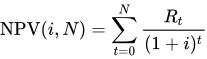
For constant greenbacks flow , the net nowadays value is a finite geometric serial and is given by:

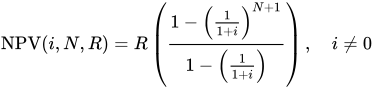
Inclusion of the term is important in the above formulae. A typical upper-case letter project involves a large negative cashflow (the initial investment) with positive futurity cashflows (the return on the investment). A cardinal assessment is whether, for a given discount rate, the NPV is positive (profitable) or negative (loss-making). The IRR is the disbelieve rate for which the NPV is exactly 0.
The discount rate [edit]
The rate used to disbelieve future cash flows to the present value is a key variable of this process.
A firm'due south weighted average price of capital (after taxation) is oftentimes used, but many people believe that it is appropriate to use higher disbelieve rates to adjust for risk, opportunity cost, or other factors. A variable discount rate with higher rates applied to greenbacks flows occurring farther forth the fourth dimension bridge might exist used to reflect the yield curve premium for long-term debt.
Another arroyo to choosing the disbelieve rate factor is to determine the rate which the capital needed for the project could return if invested in an alternative venture. If, for example, the capital required for Project A can earn 5% elsewhere, utilize this discount rate in the NPV calculation to allow a direct comparing to be fabricated betwixt Project A and the culling. Related to this concept is to utilise the firm's reinvestment charge per unit. Re-investment rate can be divers as the charge per unit of render for the house's investments on boilerplate. When analyzing projects in a capital constrained environment, information technology may exist appropriate to employ the reinvestment rate rather than the firm'due south weighted boilerplate toll of upper-case letter as the discount factor. It reflects opportunity cost of investment, rather than the perhaps lower toll of capital.
An NPV calculated using variable discount rates (if they are known for the duration of the investment) may ameliorate reflect the situation than ane calculated from a abiding disbelieve charge per unit for the unabridged investment duration. Refer to the tutorial article written by Samuel Baker[5] for more than detailed human relationship between the NPV and the discount rate.
For some professional investors, their investment funds are committed to target a specified rate of return. In such cases, that charge per unit of render should be selected as the discount rate for the NPV calculation. In this way, a directly comparing can be fabricated between the profitability of the project and the desired rate of return.
To some extent, the pick of the discount rate is dependent on the use to which it will be put. If the intent is merely to determine whether a project will add value to the company, using the house'south weighted average cost of capital may be appropriate. If trying to decide between alternative investments in club to maximize the value of the firm, the corporate reinvestment rate would probably exist a better choice.
Using variable rates over time, or discounting "guaranteed" cash flows differently from "at risk" cash flows, may be a superior methodology but is seldom used in do. Using the discount rate to arrange for risk is oftentimes hard to do in exercise (especially internationally) and is hard to do well. An culling to using discount factor to adjust for risk is to explicitly correct the cash flows for the risk elements using rNPV or a similar method, then discount at the house's charge per unit.
Employ in decision making [edit]
NPV is an indicator of how much value an investment or project adds to the firm. With a detail project, if is a positive value, the project is in the status of positive greenbacks arrival in the time oft. If is a negative value, the project is in the status of discounted cash outflow in the time ot. Accordingly risked projects with a positive NPV could be accepted. This does non necessarily hateful that they should be undertaken since NPV at the cost of capital may not business relationship for opportunity price, i.e., comparison with other available investments. In financial theory, if there is a pick between two mutually exclusive alternatives, the i yielding the higher NPV should be selected. A positive net present value indicates that the projected earnings generated by a project or investment (in present dollars) exceeds the anticipated costs (also in present dollars). This concept is the basis for the Cyberspace Present Value Rule, which dictates that the just investments that should exist fabricated are those with positive NPVs.
An investment with a positive NPV is profitable, but ane with a negative NPV volition not necessarily result in a net loss: information technology is just that the internal charge per unit of return of the project falls beneath the required rate of return.
| If... | It means... | Then... |
|---|---|---|
| NPV > 0 | the investment would add value to the house | the projection may be accepted |
| NPV < 0 | the investment would subtract value from the business firm | the project may exist rejected |
| NPV = 0 | the investment would neither gain nor lose value for the firm | We should exist indifferent in the conclusion whether to accept or reject the project. This project adds no monetary value. Decision should be based on other criteria, due east.1000., strategic positioning or other factors not explicitly included in the calculation. |
Interpretation as integral transform [edit]
The fourth dimension-discrete formula of the net present value
tin can as well be written in a continuous variation

where
- r(t) is the rate of flowing cash given in money per time, and r(t) = 0 when the investment is over.
Internet nowadays value can exist regarded as Laplace-[half dozen] respectively Z-transformed cash menstruum with the integral operator including the complex number s which resembles to the involvement rate i from the existent number space or more precisely s = ln(one +i).

From this follow simplifications known from cybernetics, control theory and system dynamics. Imaginary parts of the circuitous number s describe the oscillating behaviour (compare with the pork cycle, cobweb theorem, and phase shift between article price and supply offer) whereas existent parts are responsible for representing the result of compound involvement (compare with damping).
Case [edit]
A corporation must decide whether to innovate a new product line. The visitor will have immediate costs of 100,000 att = 0. Recall, a toll is a negative for outgoing cash flow, thus this cash flow is represented equally −100,000. The visitor assumes the production will provide equal benefits of 10,000 for each of 12 years first att = 1. For simplicity, presume the company will have no approachable cash flows after the initial 100,000 toll. This also makes the simplifying assumption that the net greenbacks received or paid is lumped into a unmarried transaction occurring on the last mean solar day of each year. At the end of the 12 years the production no longer provides whatsoever cash flow and is discontinued without any additional costs. Assume that the effective annual discount rate is x%.
The nowadays value (value att = 0) tin be calculated for each year:
| Year | Cash menstruation | Nowadays value |
|---|---|---|
| T = 0 | −100,000 | |
| T = one | 9,090.91 | |
| T = two | 8,264.46 | |
| T = 3 | 7,513.15 | |
| T = 4 | 6,830.13 | |
| T = 5 | 6,209.21 | |
| T = 6 | 5,644.74 | |
| T = 7 | 5,131.58 | |
| T = 8 | 4,665.07 | |
| T = 9 | 4,240.98 | |
| T = 10 | iii,855.43 | |
| T = 11 | 3,504.94 | |
| T = 12 | three,186.31 |


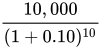
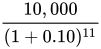
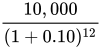
The full nowadays value of the incoming cash flows is 68,136.91. The total present value of the outgoing greenbacks flows is just the 100,000 at fourth dimensiont = 0. Thus:

In this example:


Observe that as t increases the present value of each greenbacks menstruum at t decreases. For case, the last incoming greenbacks menstruum has a future value of 10,000 at t = 12 but has a present value (att = 0) of three,186.31. The opposite of discounting is compounding. Taking the example in reverse, it is the equivalent of investing 3,186.31 at t = 0 (the present value) at an interest rate of 10% compounded for 12 years, which results in a cash catamenia of 10,000 at t = 12 (the future value).
The importance of NPV becomes clear in this instance. Although the incoming greenbacks flows (ten,000 × 12 = 120,000) appear to exceed the outgoing greenbacks flow (100,000), the future cash flows are non adjusted using the discount rate. Thus, the project appears misleadingly assisting. When the cash flows are discounted nevertheless, it indicates the project would result in a net loss of 31,863.09. Thus, the NPV calculation indicates that this project should exist disregarded considering investing in this project is the equivalent of a loss of 31,863.09 att = 0. The concept of time value of money indicates that cash flows in different periods of fourth dimension cannot exist accurately compared unless they have been adjusted to reflect their value at the aforementioned period of fourth dimension (in this case,t = 0).[2] It is the present value of each future cash menstruum that must be determined in order to provide any meaningful comparison between cash flows at different periods of time. There are a few inherent assumptions in this type of assay:
- The investment horizon of all possible investment projects considered are every bit acceptable to the investor (due east.chiliad. a 3-year project is not necessarily preferable vs. a 20-year project.)
- The 10% discount rate is the appropriate (and stable) rate to discount the expected cash flows from each project being considered. Each project is assumed as speculative.
- The shareholders cannot get in a higher place a ten% render on their money if they were to directly assume an equivalent level of risk. (If the investor could do better elsewhere, no projects should be undertaken by the firm, and the excess capital should be turned over to the shareholder through dividends and stock repurchases.)
More realistic problems would also demand to consider other factors, generally including: smaller time buckets, the calculation of taxes (including the cash flow timing), aggrandizement, currency substitution fluctuations, hedged or unhedged commodity costs, risks of technical obsolescence, potential future competitive factors, uneven or unpredictable cash flows, and a more realistic salvage value assumption, every bit well as many others.
A more uncomplicated example of the internet present value of incoming cash period over a fix period of time, would exist winning a Powerball lottery of $500 1000000. If one does non select the "Greenbacks" option they volition be paid $25,000,000 per year for 20 years, a total of $500,000,000, however, if 1 does select the "CASH" choice, they volition receive a old lump sum payment of approximately $285 1000000, the NPV of $500,000,000 paid over time. Encounter "other factors" above that could affect the payment amount. Both scenarios are before taxes.
Mutual pitfalls [edit]
- If, for case, the R t are mostly negative tardily in the project (e.one thousand., an industrial or mining projection might have clean-upwardly and restoration costs), and then at that phase the company owes money, so a loftier discount rate is not cautious but besides optimistic. Some people see this every bit a problem with NPV. A way to avoid this problem is to include explicit provision for financing any losses afterwards the initial investment, that is, explicitly summate the cost of financing such losses.
- Some other common pitfall is to adjust for risk past calculation a premium to the disbelieve rate. Whilst a bank might charge a higher rate of interest for a risky project, that does not mean that this is a valid arroyo to adjusting a internet nowadays value for risk, although information technology can be a reasonable approximation in some specific cases. I reason such an approach may not work well can be seen from the following: if some take a chance is incurred resulting in some losses, then a disbelieve charge per unit in the NPV will reduce the upshot of such losses below their true financial cost. A rigorous approach to risk requires identifying and valuing risks explicitly, eastward.thou., by actuarial or Monte Carlo techniques, and explicitly calculating the toll of financing any losses incurred.
- Still another upshot can result from the compounding of the adventure premium. R is a blended of the take a chance gratuitous rate and the risk premium. As a upshot, future cash flows are discounted by both the adventure-free charge per unit also as the risk premium and this effect is compounded by each subsequent greenbacks flow. This compounding results in a much lower NPV than might exist otherwise calculated. The certainty equivalent model tin be used to account for the risk premium without compounding its consequence on nowadays value.[ citation needed ]
- Some other result with relying on NPV is that information technology does not provide an overall picture of the proceeds or loss of executing a certain project. To meet a percentage gain relative to the investments for the project, usually, Internal rate of return or other efficiency measures are used equally a complement to NPV.
- Non-specialist users frequently make the error of computing NPV based on cash flows afterward interest. This is wrong because it double counts the time value of money. Costless cash flow should be used equally the ground for NPV computations.
History [edit]
Net nowadays value every bit a valuation methodology dates at least to the 19th century. Karl Marx refers to NPV as fictitious capital letter, and the calculation as "capitalising," writing:[7]
The forming of a fictitious capital letter is called capitalising. Every periodically repeated income is capitalised past calculating it on the average charge per unit of interest, as an income which would be realised by a capital at this rate of involvement.
In mainstream neo-classical economics, NPV was formalized and popularized by Irving Fisher, in his 1907 The Charge per unit of Interest and became included in textbooks from the 1950s onwards, starting in finance texts.[8] [9]
Alternative capital budgeting methods [edit]
- Adapted nowadays value (APV): adjusted present value, is the internet present value of a project if financed solely by ownership equity plus the present value of all the benefits of financing.
- Accounting rate of return (ARR): a ratio similar to IRR and MIRR
- Cost-do good assay: which includes problems other than greenbacks, such as fourth dimension savings.
- Internal charge per unit of return (IRR): which calculates the rate of return of a project while disregarding the absolute amount of coin to be gained.
- Modified internal rate of return (MIRR): similar to IRR, but information technology makes explicit assumptions about the reinvestment of the cash flows. Sometimes it is chosen Growth Rate of Render.
- Payback menstruum: which measures the time required for the cash inflows to equal the original outlay. It measures risk, not return.
- Real pick: which attempts to value managerial flexibility that is assumed away in NPV.
- Equivalent annual price (EAC): a uppercase budgeting technique that is useful in comparison two or more projects with unlike lifespans.
See besides [edit]
- Profitability index
References [edit]
- ^ Lin, Grier C. I.; Nagalingam, Sev V. (2000). CIM justification and optimisation. London: Taylor & Francis. p. 36. ISBN0-7484-0858-4.
- ^ a b Berk, DeMarzo, and Stangeland, p. 94.
- ^ erk, DeMarzo, and Stangeland, p. 64.
- ^ Khan, M.Y. (1993). Theory & Bug in Financial Direction. Boston: McGraw Hill Higher Education. ISBN978-0-07-463683-ane.
- ^ Baker, Samuel L. (2000). "Perils of the Internal Rate of Return". Retrieved January 12, 2007.
- ^ Steven Buser: LaPlace Transforms as Present Value Rules: A Notation, The Journal of Finance, Vol. 41, No. 1, March, 1986, pp. 243–247.
- ^ Karl Marx, Upper-case letter, Volume 3, 1909 edition, p. 548
- ^ Bichler, Shimshon; Nitzan, Jonathan (July 2010), Systemic Fear, Modern Finance and the Hereafter of Capitalism (PDF), Jerusalem and Montreal, pp. 8–xi (for discussion of history of use of NPV as "capitalisation")
- ^ Nitzan, Jonathan; Bichler, Shimshon (2009), Capital as Power. A Study of Order and Creorder., RIPE Series in Global Political Economic system, New York and London: Routledge
brzozowskibectionet.blogspot.com
Source: https://en.wikipedia.org/wiki/Net_present_value
0 Response to "Risk in a Revenue Producing Project Can Best Be Adjusted for by"
Post a Comment