Phenomenon of a Topic Coming Up Again Frequently
Information technology feels uncanny, but is in fact all virtually how our attending works, says Anina Rich, Professor in the Section of Cerebral Science.
We've all been there. An obscure word we've never seen earlier captures our attention. Then, suddenly, nosotros first to see that discussion pop upwards all over the place. Or you lot're thinking about buying a particular car, and you lot begin noticing the aforementioned make and model seemingly everywhere.

Second take: Seeing the aforementioned machine everywhere is one example of the Baader-Meinhof Phenomenon at work.
Information technology is known as the Frequency Illusion or Bias and, more than informally, the Baader-Meinhof Phenomenon. The latter coining was apparently by a newspaper reader in Minnesota, U.s.a., who, in a alphabetic character to the newspaper in 1994 described it as a phenomenon in which, later the first fourth dimension y'all acquire a new discussion, phrase or idea, you run across that word, phrase or idea again within 24 hours.
Information technology was named after an incident in which the reader, Terry Mullen, was talking to a friend near the in one case notorious W German language Baader-Meinhof gang, and the next day, the friend referred Mullen to an article in that mean solar day'south newspaper in which the left-wing terrorist arrangement was mentioned, decades later it had any reason to be in the news.
We need to be responsive to what happens in the environment in society to stay safe. At the same time, if we can't ignore our surroundings, we wouldn't be able to consummate any tasks.
More than 10 years afterward, the term Frequency Illusion was coined past Stanford linguist Arnold Zwicky. Essentially, the Frequency Illusion is a perception that something you've been thinking about, or recently learned, of a sudden seems much more frequent in your environment than it was before.
In that location are two parts to it. One part is the perception of increased frequency; the second part is a confirmation bias where you believe that it didn't happen before at the same frequency. But in reality, the frequency hasn't inverse, you lot merely weren't noticing it because your attending wasn't being fatigued to it.
There aren't many scientific papers nearly Frequency Illusion, simply the event closely resembles 'working memory-driven attentional capture', which I've studied to explore how attention is guided. This is a fashion of describing what happens when something you are holding in listen influences where your attention goes.
True cat versus piano
Imagine you are looking at a reckoner screen with different items on it, a 'visual search' brandish. If I inquire you lot to offset remember a item particular, say a piano, and then I show you a visual search display and ask you to look for a cat, the presence of a piano as a distractor in the display makes yous slower to detect the cat than if the piano is not there.
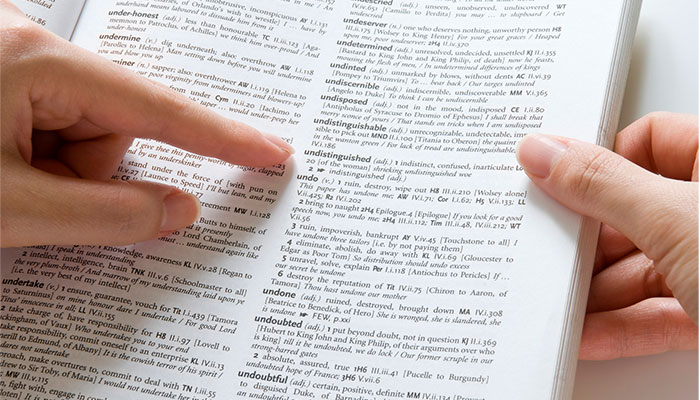
Heed games: Seeing a word for the commencement time, so again soon afterwards, is a common feel of the phenomenon.
And then, fifty-fifty though the memory item – the piano – is irrelevant to your visual search task, if information technology is nowadays, it captures your attention, slowing your search for your target detail (the true cat). Nosotros tin use visual search times to look at how attention is guided under different atmospheric condition.
Working retentiveness-driven attentional capture is very similar to what is happening in the Baader-Meinhof Phenomenon: something you are holding in your heed then draws your attention to that matter in the environment in a way you don't unremarkably discover. It is a nice illustration of the unconscious influences on where our attention goes.
Competing for your attending
Where attention is deployed at any given moment is a dynamic interaction between what is happening in the earth around you and what your current goal is. Voluntary attention allows united states of america to select data that is relevant to what we are doing right now. Involuntary capture of attention happens when something else external draws our attending from that task.
In an evolutionary sense, nosotros demand to be responsive to what happens in the environment in order to stay safe. But at the same time, if we can't effectively ignore our surround, we wouldn't exist able to complete whatsoever tasks. And attention is crucial for learning and for memory – if you are non paying attention to something you are not going to remember it.
- World-first lung repair shows hope
- 7 positive outcomes of COVID-19
Ane of my enquiry topics is the interaction between where you want your attention to go – that is, the task you lot are currently focusing on – and what is happening in the environment – that is, what captures your attention without your will.
The Frequency Illusion shows the interaction of factors that direct your attention; what yous are thinking about unconsciously guides you to relevant information in the environment. It shows how important information technology is to empathise how attending works – information technology is fundamental to everything we do, and has a major influence on what we perceive around us.
Our power to function in our complex globe relies crucially on the capacity to select what's relevant and ignore what's irrelevant at whatsoever given moment. That's why I written report attention!
Anina Rich is a Professor in the Department of Cerebral Science.
brzozowskibectionet.blogspot.com
Source: https://lighthouse.mq.edu.au/article/july-2020/What-is-the-Baader-Meinhof-Phenomenon
0 Response to "Phenomenon of a Topic Coming Up Again Frequently"
Post a Comment